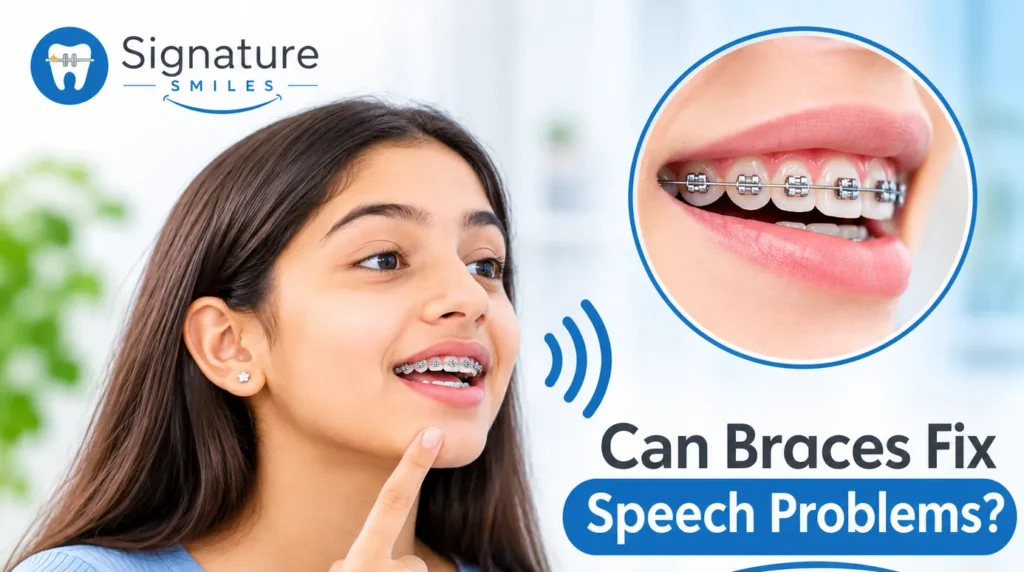

Have you ever noticed that certain words are difficult to pronounce, or that you struggle with sounds such as “S,” “Z,” “T,” or “D”? Speech difficulties can sometimes be related to the position of your teeth, jaw alignment, or the way your tongue moves inside your mouth.
Many people wonder whether braces can fix speech problems and whether correcting misaligned teeth can improve their pronunciation. The answer is yes, in some cases. Orthodontic treatment can help improve certain speech difficulties when they are caused by dental misalignment or bite problems. However, not every speech problem is related to the position of the teeth.
Understanding the connection between orthodontics and speech can help you decide whether an orthodontic consultation is the right step.
At Signature Smiles Orthodontics, Pune, Dr. Aditi Kulkarni focuses on diagnosing and treating teeth alignment and bite-related concerns to support better oral function and a confident smile.
How Are Teeth Alignment and Speech Connected?
Speech involves the coordinated movement of the tongue, lips, teeth, and jaw. When we speak, air passes through the mouth, and different sounds are produced by placing the tongue and lips in specific positions.
Your front teeth, in particular, play an important role in producing certain sounds. For example:
- S and Z sounds: The tongue moves close to the front teeth to direct airflow.
- T and D sounds: The tongue touches the area just behind the upper front teeth.
- F and V sounds: The upper front teeth come into contact with the lower lip.
- TH sounds: The tongue moves slightly between or near the front teeth.
If the teeth are significantly misaligned, the bite is incorrect, or there are gaps between the teeth, the airflow and tongue positioning may change. This can sometimes affect pronunciation and speech clarity.
Can Braces Fix Speech Problems?
Yes, braces can help improve certain speech problems when the underlying cause is related to teeth positioning or bite alignment.
Braces gradually move teeth into more appropriate positions using controlled orthodontic forces. By correcting dental alignment and improving the bite, orthodontic treatment may help create a more suitable environment for proper tongue placement and airflow.
However, it is important to understand that braces are not a universal treatment for speech disorders. If speech difficulties are caused by neurological conditions, hearing problems, developmental issues, or incorrect speech habits, additional treatment may be necessary.
An orthodontist can assess whether dental alignment is contributing to your speech concerns.
Which Dental Problems Can Affect Speech?
Several orthodontic conditions may influence the way a person speaks. Some common examples include:
1. Overbite
An overbite occurs when the upper front teeth overlap the lower front teeth excessively. Depending on its severity, it may affect the positioning of the lips and tongue during speech.
2. Underbite
An underbite occurs when the lower front teeth extend beyond the upper front teeth. This jaw and bite relationship may affect the way certain sounds are produced.
3. Open Bite
An open bite occurs when the upper and lower front teeth do not meet when the mouth is closed. This can allow the tongue to move forward between the teeth, sometimes contributing to a lisp or difficulty pronouncing certain sounds.
4. Spacing Between Teeth
Large gaps between the front teeth may allow air to escape differently during speech. This can sometimes affect the pronunciation of sounds such as S and Z.
5. Crowded or Crooked Teeth
Severely crowded or overlapping teeth can change the available space for tongue movement. In some individuals, this may contribute to pronunciation difficulties.
Not everyone with these dental conditions will experience speech problems. The impact depends on the individual’s bite, tongue position, and speaking habits.
Can Braces Cause Speech Problems Initially?
Yes. Interestingly, while braces may help correct certain dental issues that contribute to speech difficulties, wearing braces can temporarily affect speech in the beginning.
When braces are first fitted, the mouth needs time to adjust to the brackets and wires. The tongue may initially find it difficult to move comfortably around the new orthodontic appliances.
Some patients may notice:
- A temporary lisp while speaking.
- Difficulty pronouncing S and Z sounds.
- Slight changes in pronunciation.
- Increased saliva production.
- A feeling of fullness or discomfort inside the mouth.
These changes are generally temporary. Most patients gradually adapt as their tongue becomes familiar with the braces.
How Long Does It Take to Speak Normally After Getting Braces?
Most patients adjust to speaking with braces within a few days to a couple of weeks. However, the adjustment period varies depending on the type of braces, individual oral anatomy, and speaking habits.
Here are some practical tips to help you adjust faster:
- Read aloud every day: Reading books, newspapers, or articles aloud helps your tongue adapt to the braces.
- Practise difficult sounds: Repeat words containing S, Z, T, D, and TH sounds.
- Speak slowly and clearly: Avoid rushing while speaking during the initial adjustment period.
- Stay hydrated: Drinking sufficient water helps prevent mouth dryness and improves comfort.
- Practise conversations: Regular conversations help you become comfortable speaking with braces.
If speech difficulties continue or become worse, consult your orthodontist for an evaluation.
Do Different Types of Braces Affect Speech Differently?
Yes. Different orthodontic appliances can have different effects on speech during the adjustment period.
- Metal braces: Traditional metal braces may temporarily affect tongue movement and pronunciation as the mouth adjusts to brackets and wires.
- Ceramic braces: These work similarly to metal braces and may cause comparable initial speech adjustments.
- Lingual braces: These are attached to the inner surfaces of the teeth. Since they are closer to the tongue, some patients may experience more noticeable pronunciation difficulties initially.
- Clear aligners: These removable transparent trays cover the teeth and may temporarily affect the pronunciation of certain sounds.
The right treatment depends on your dental condition, bite, lifestyle, and orthodontic requirements. Your orthodontist can help you choose an appropriate option.
Can Children Develop Speech Problems Due to Misaligned Teeth?
Yes, certain dental and jaw development problems in children may contribute to speech difficulties.
For example, children with an open bite, excessive spacing, or an incorrect tongue resting position may experience difficulty producing particular sounds. Some children also develop tongue-thrust habits, where the tongue pushes forward against or between the teeth while swallowing or speaking.
Early orthodontic evaluation can help identify developing bite problems. If speech difficulties are present, an orthodontist may recommend an assessment by a qualified speech-language pathologist.
Early diagnosis can help parents understand whether the concern is dental, muscular, developmental, or related to speech habits.
Are Braces Alone Enough to Correct Speech Problems?
Not always. Although orthodontic treatment can correct dental alignment issues, some speech problems require additional support.
Depending on the underlying cause, treatment may involve:
- Orthodontic treatment: To correct crooked teeth, gaps, open bites, and other bite irregularities.
- Speech therapy: To improve pronunciation, articulation, and correct speech habits.
- Myofunctional therapy: To address certain abnormal tongue, lip, and facial muscle patterns under appropriate professional guidance.
An orthodontist and speech-language pathologist may work together to develop a treatment approach when both dental alignment and speech difficulties are involved.
Frequently Asked Questions About Braces and Speech Problems
1. Will my speech improve after getting braces?
If your speech difficulty is related to misaligned teeth or bite problems, orthodontic treatment may help improve pronunciation over time. However, results depend on the underlying cause.
2. Can braces correct a lisp?
Braces may help in certain cases where a lisp is associated with an open bite, gaps between the front teeth, or dental positioning. However, speech therapy may also be required to correct tongue placement and pronunciation habits.
3. Will I develop a lisp after getting braces?
Some patients experience a temporary lisp after getting braces, particularly when pronouncing S and Z sounds. This usually improves as the tongue adapts to the orthodontic appliance.
4. Are clear aligners better than braces for speech?
Clear aligners and traditional braces can both temporarily affect speech. The impact varies between individuals. Your orthodontist can recommend the most suitable option based on your dental condition.
5. Should I consult an orthodontist for speech difficulties?
If you have crooked teeth, an incorrect bite, gaps, or an open bite along with pronunciation difficulties, an orthodontic consultation can help determine whether dental alignment is contributing to the problem.
6. When should parents take their child for an orthodontic consultation?
An initial orthodontic evaluation is generally recommended by age seven, as advised by orthodontic professional guidelines. Parents should seek an earlier dental or speech assessment if they notice significant concerns.
Improve Your Smile and Oral Function with Expert Orthodontic Care in Pune
Speech difficulties can sometimes be connected to dental alignment and jaw positioning. While braces may help address certain underlying orthodontic problems, every patient’s condition is different. Identifying the actual cause is essential before starting treatment.
At Signature Smiles Orthodontics, Dr. Aditi Kulkarni, Orthodontist in Pune, provides orthodontic evaluation and treatment planning based on individual dental needs. Whether you have crowded teeth, an open bite, spacing issues, or concerns about your bite, a professional assessment can help you understand your treatment options.
If you or your child experiences speech difficulties along with teeth alignment problems, consider scheduling an orthodontic consultation.
Take the first step towards a healthier, well-aligned, and confident smile with Signature Smiles Orthodontics, Pune.
Address: Shop no. 1, Ekta Apartments, Law College Rd, near NAL Stop, Pune, Maharashtra 411038
Call Now: 88883 34511
Get Direction