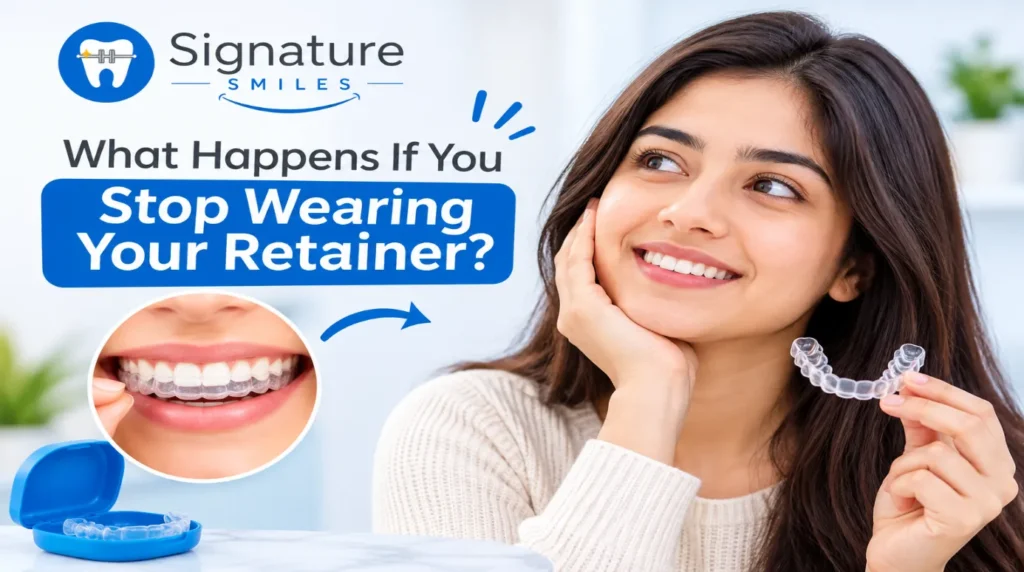

Completing orthodontic treatment and finally getting your braces or aligners removed is an exciting milestone. After months or sometimes years of treatment, you can enjoy your new, straight smile. However, maintaining those results requires one important step: wearing your retainer regularly.
Many people assume that once their teeth are straight, they will remain in the same position forever. Unfortunately, this is not always true. If you stop wearing your retainer, your teeth can gradually shift back towards their original positions. This movement is known as orthodontic relapse.
So, what happens if you stop wearing your retainer for a few days, weeks, or even months? Can your teeth become crooked again? Will you need braces for a second time?
In this blog, Dr. Aditi Kulkarni, Orthodontist in Pune at Signature Smiles Orthodontics, explains why retainers are important, what happens when you stop wearing them, and how you can protect your orthodontic results.
What Is a Dental Retainer and Why Is It Important?
A dental retainer is a customised orthodontic appliance designed to keep your teeth in their corrected positions after braces or clear aligner treatment.
During orthodontic treatment, braces and aligners gradually move your teeth into their desired positions. However, the surrounding gums, periodontal ligaments, and supporting bone need time to adapt to these changes.
Even after your braces are removed, your teeth naturally tend to move throughout life. Retainers help prevent unwanted movement and maintain the alignment achieved through orthodontic treatment.
There are three common types of retainers:
1. Removable Clear Retainers: These transparent, customised retainers fit over your teeth and are nearly invisible when worn.
2. Hawley Retainers: These removable retainers generally consist of an acrylic base and a thin metal wire that holds the teeth in position.
3. Fixed or Permanent Retainers: These consist of a thin wire bonded behind the front teeth to maintain their alignment continuously.
Your orthodontist will recommend the appropriate retainer based on your teeth, treatment results, and individual requirements.
What Happens If You Stop Wearing Your Retainer?
Stopping retainer use can lead to several changes in your teeth and bite. The effects depend on how long you stop wearing it, your original dental condition, and your orthodontic treatment history.
Here are the most common consequences.
1. Your Teeth May Start Shifting Back
The most common consequence of not wearing a retainer is teeth shifting. Your teeth are supported by surrounding tissues that continue adapting even after orthodontic treatment.
Without a retainer, your teeth may gradually move towards their previous positions. This is particularly noticeable in the front teeth, which may develop small gaps, crowding, or overlapping.
2. You May Experience Orthodontic Relapse
Orthodontic relapse occurs when teeth partially or completely return towards their original positions after treatment.
For example, if you previously had crowded front teeth, they may begin overlapping again if you do not wear your retainer as recommended.
Relapse can affect the appearance of your smile and may require additional orthodontic treatment to correct.
3. Small Gaps May Reappear Between Your Teeth
If you previously had spaces between your teeth, those gaps may gradually reopen without proper retainer use.
Even small movements can affect your smile’s appearance and may make you feel that your previous orthodontic treatment results are disappearing.
4. Your Bite Alignment May Change
Retainers do more than maintain straight teeth. They also help preserve the bite correction achieved during orthodontic treatment.
Without consistent retainer use, unwanted tooth movement may affect how your upper and lower teeth meet. In some cases, this can lead to changes in your bite and uneven contact between certain teeth.
5. Your Retainer May No Longer Fit Properly
If you stop wearing your removable retainer for an extended period, your teeth may move enough to change its fit.
You might notice that your retainer feels tight, uncomfortable, or difficult to put on.
Never force a retainer that does not fit properly. Doing so may put excessive pressure on your teeth and gums. Consult your orthodontist to determine the safest next step.
How Quickly Do Teeth Move After Stopping Retainer Use?
There is no fixed timeline because every person’s teeth respond differently. However, some patients notice changes surprisingly quickly.
Here is what may happen:
- After a few days: Your teeth may feel slightly tight when you put your retainer back in.
- After a few weeks: Minor tooth movements may become noticeable, and your retainer may feel tighter than usual.
- After a few months: More visible shifting, crowding, or spacing may develop.
- After several months or years: Significant orthodontic relapse may occur, potentially requiring further treatment.
These are general possibilities, not guaranteed timelines. Tooth movement depends on several factors, including age, previous orthodontic problems, and individual biology.
Can Teeth Go Back to Their Original Position Without a Retainer?
Yes. Teeth can gradually move towards their original positions if retainers are not worn as instructed.
However, complete relapse does not happen to everyone. Some patients experience only minor changes, while others may develop noticeable crowding or spacing.
The risk is generally higher during the initial period after braces or aligner treatment because the surrounding supporting tissues are still adapting.
This is why orthodontists recommend following a long-term retainer-wearing schedule rather than stopping immediately after treatment.
What Should You Do If You Have Stopped Wearing Your Retainer?
If you have not worn your retainer for several days, weeks, or months, do not panic. The first step is to understand whether your teeth have shifted.
Follow these recommendations:
1. Check Your Retainer Fit
Try to identify whether your retainer fits comfortably. Do not force it into place if it feels excessively tight or does not fit completely.
2. Avoid Using an Old or Damaged Retainer Without Advice
Cracked, distorted, or poorly fitting retainers may not provide the correct support. Get them checked by your orthodontist.
3. Schedule an Orthodontic Consultation
Visit your orthodontist to assess whether your teeth have moved and whether your existing retainer can still be used safely.
4. Discuss Whether a New Retainer Is Needed
If your teeth have shifted slightly, a new customised retainer may be sufficient in some cases. However, more significant movement may require additional orthodontic treatment.
5. Follow Your Updated Retainer Schedule
Once your orthodontist confirms the appropriate appliance and fit, follow the recommended wearing instructions consistently.
Can You Straighten Your Teeth Again Without Braces?
It depends on how much your teeth have shifted.
If the movement is minor, your orthodontist may recommend a replacement retainer or other suitable options. However, a retainer is not designed to correct significant tooth movement.
If your teeth have become noticeably crooked again, clear aligners or braces may be necessary to restore their alignment.
Modern orthodontic treatments offer different options depending on your dental condition, treatment history, and smile goals.
An orthodontic examination is essential before deciding which treatment is suitable.
How Long Should You Wear Your Retainer After Braces?
Retainer use is a long-term commitment. Many patients need to wear their retainers at night indefinitely to maintain their orthodontic results.
Your orthodontist will provide a personalised schedule depending on your treatment and dental condition.
Here are some important retainer care tips:
- Wear your retainer according to your orthodontist’s instructions.
- Clean your removable retainer regularly using recommended cleaning methods.
- Store it in its protective case when not in use.
- Avoid exposing it to hot water, which can distort its shape.
- Never wrap it in tissue or leave it where it can be damaged.
- Attend regular orthodontic follow-up appointments.
- Contact your orthodontist if your retainer becomes loose, cracked, or uncomfortable.
Consistency is the key to maintaining a healthy, properly aligned smile.
Why Choose Signature Smiles Orthodontics in Pune?
Maintaining your smile after orthodontic treatment requires proper guidance, regular monitoring, and a personalised retention plan.
At Signature Smiles Orthodontics, Dr. Aditi Kulkarni provides orthodontic care focused on achieving and maintaining healthy, well-aligned smiles.
Whether you have recently completed braces treatment, finished clear aligner treatment, or noticed your teeth shifting after stopping retainer use, an orthodontic consultation can help determine the right approach.
If you are looking for an orthodontist in Pune for retainer treatment and teeth alignment, professional assessment can help you protect your smile and understand the treatment options available.
Book your orthodontic consultation at Signature Smiles Orthodontics, Pune, and take the right steps towards maintaining your beautiful smile.
Call Now: 8888334511
Address: Shop No. 1, Ekta Apartments, Law College Road, Near Nal Stop, Erandawane, Pune – 411004
Frequently Asked Questions (FAQs)
1. Is it okay to stop wearing my retainer after one year?
Not necessarily. Teeth can continue shifting throughout life. Many patients require long-term or lifelong nighttime retainer use. Follow your orthodontist’s recommendations before changing your routine.
2. Can my teeth shift after not wearing a retainer for one week?
Yes. Some people may experience minor tooth movement within a week, although the amount varies. Your retainer may feel tighter when you try wearing it again.
3. Will my teeth become crooked again if I stop wearing my retainer?
They can. Without regular retainer use, teeth may gradually move towards their original positions, causing crowding, gaps, or bite changes.
4. Can I wear my old retainer after several months?
Only if it still fits properly and your orthodontist confirms that it is safe to use. Never force an old retainer onto teeth that have shifted.
5. Do I need braces again if my teeth have shifted?
Not always. Minor movements may be manageable with an appropriate new retainer or other treatment. Significant relapse may require braces or clear aligners.
6. Where can I consult an orthodontist in Pune for retainer problems?
You can consult Dr. Aditi Kulkarni at Signature Smiles Orthodontics in Pune for an orthodontic evaluation, retainer assessment, and guidance on maintaining your teeth alignment.